Does a Pedestrian Always Have the Right of Way in a Texas Crosswalk?
Not always. Texas law gives pedestrians significant crosswalk protections, but also places duties on them, and drivers carry an ongoing legal obligation to avoid striking pedestrians regardless of signal status. Pedestrians must follow pedestrian control signals where they exist and may not step suddenly into traffic when it is impossible for a driver to yield in time.
Pedestrian right of way in Texas is not as straightforward as most people assume, and the gap between what the law requires of drivers and what those drivers actually do is where most serious pedestrian injuries happen. Texas law gives pedestrians meaningful protections at marked and unmarked crosswalks, but it also places duties on pedestrians, and insurance companies regularly use those duties to reduce what they pay after a crash. Understanding how these rules apply in Houston intersections, school zones, and mid-block locations can directly affect what an injured pedestrian may recover.
Key Takeaways About Texas Crosswalk Rights and Liability
- Texas Transportation Code § 552 gives pedestrians the right of way at crosswalks, but also requires them to follow pedestrian signals and avoid stepping abruptly into moving traffic
- Both marked and unmarked crosswalks carry legal protections under Texas law, though the strength of those protections can differ in practice
- Crossing outside a crosswalk can increase a pedestrian's fault percentage in a civil injury claim, even though Texas no longer allows cities to issue jaywalking fines
- Drivers in Texas carry a legal duty to exercise due care to avoid hitting pedestrians, even when the pedestrian has stepped outside the crosswalk
- Under Texas's 51% comparative fault rule, an injured pedestrian may still recover compensation as long as their assigned fault stays at 50% or below
Key Statistics About Pedestrian Accidents in Texas
- The National Highway Traffic Safety Administration (NHTSA) reported 7,508 pedestrian fatalities across the United States in 2022, the highest total in four decades
- According to the Texas Department of Transportation (TxDOT), pedestrians consistently account for a significant share of Texas traffic fatalities each year, with major urban corridors in Houston among the most dangerous stretches in the state
- NHTSA data shows that approximately 76 percent of pedestrian fatalities occur outside of intersections, meaning most fatal pedestrian crashes happen in mid-block crossings and areas without marked crosswalks
These numbers reflect why understanding where legal protections apply, and where they weaken, matters so much for pedestrians injured on Houston roads.
What Does Texas Law Actually Require Drivers to Do at Crosswalks?
Texas law requires drivers to yield to pedestrians in crosswalks and to exercise due care to avoid striking anyone on foot, regardless of whether the pedestrian is fully within the crosswalk or following the signal.
What Does Texas Transportation Code § 552 Say?
Under Texas Transportation Code § 552, a driver approaching a crosswalk must stop and remain stopped while a pedestrian is crossing within it. The driver may not proceed until the pedestrian has completely cleared the travel lane.
The same statute requires drivers to exercise due care, meaning the level of caution a reasonable person would use under similar conditions, to avoid colliding with a pedestrian anywhere on the roadway. This duty applies even when the pedestrian is not in full compliance with the rules.
Do Drivers Have to Yield Even When There Is No Traffic Signal?
Yes. A driver must yield to pedestrians in a crosswalk even when no traffic signal controls the intersection. Texas law does not limit the yield requirement to signalized crossings.
This matters throughout Houston neighborhoods where crosswalks are not painted or marked, but the intersection itself still qualifies as a legal crosswalk location under Texas law.
What Is the Difference Between a Marked and Unmarked Crosswalk in Texas?
Marked and unmarked crosswalks both exist under Texas law, but they are not identical in how courts and insurers treat them after a crash.
What Qualifies as a Marked Crosswalk Under Texas Law?
A marked crosswalk is a crossing area physically designated with painted lines, reflective markings, or other pavement indicators. These are the crosswalks most people recognize at signalized intersections along Houston streets like Westheimer, Main Street, and in the Medical Center district.
Marked crosswalks tend to produce clearer evidence that a pedestrian was in a protected area when struck. Surveillance footage often resolves crosswalk-fault disputes and is far easier to interpret when crosswalk boundaries are visible on camera.
Are Pedestrian Protections Different at Unmarked Crosswalks?
An unmarked crosswalk exists by operation of law at any intersection where sidewalks or road shoulders meet the roadway, even with no paint or signage. A pedestrian crossing at a standard four-way intersection has crosswalk rights even if there are no visible markings on the pavement.
The legal right of way is the same as a marked crosswalk. However, proving a pedestrian was in an unmarked crosswalk at the time of a crash tends to require more evidence. Witness accounts, intersection geometry, and traffic camera footage become especially important in these cases.
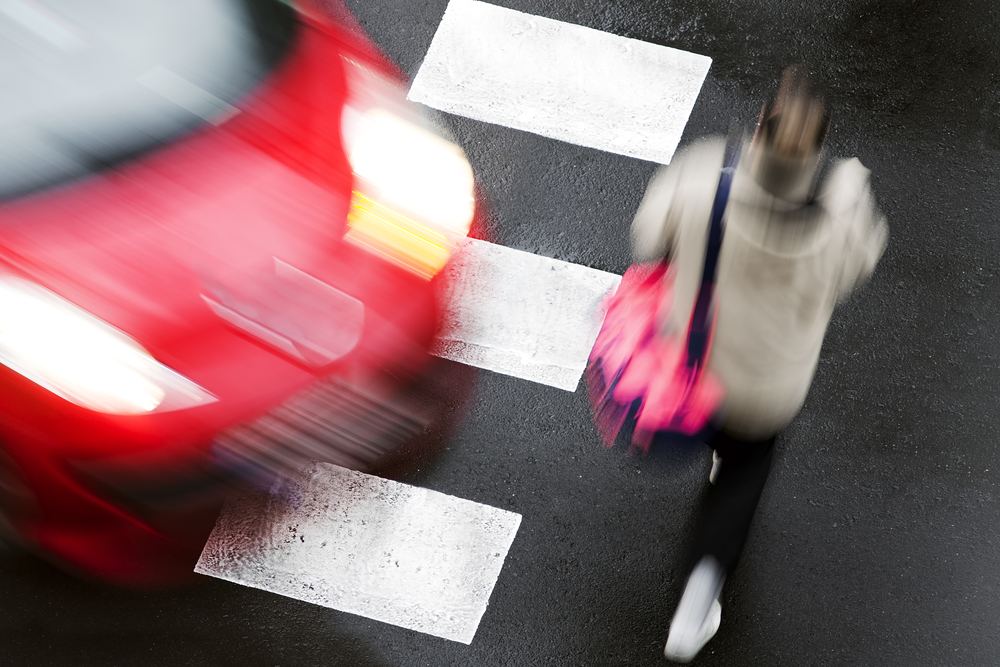
| Where You Were Crossing | Legal Right of Way? | Driver's Duty | Comparative Fault Risk to Pedestrian |
|---|---|---|---|
| Marked crosswalk with Walk signal | Yes, full | Must stop and remain stopped | Low |
| Marked crosswalk against Don't Walk signal | Limited | Must still yield if pedestrian is already in crosswalk | Moderate — signal violation is a fault factor |
| Unmarked crosswalk at intersection | Yes | Must stop and yield | Low to moderate — harder to prove location |
| Mid-block with no crosswalk nearby | No specific right of way | Must still exercise due care | Higher — crossing duty shifts to pedestrian |
| Mid-block near an available crosswalk | No specific right of way | Must still exercise due care | Higher — insurer will argue crosswalk was available and unused |
When Does a Pedestrian Not Have the Right of Way in Texas?
Pedestrians do not have unlimited right of way under Texas law. The same statute that protects pedestrians in crosswalks also places specific duties on them.
What Duties Does Texas Law Place on Pedestrians?
Under Texas Transportation Code § 552, pedestrians must obey pedestrian control signals where they exist. A pedestrian who crosses against a "Don't Walk" signal, or who steps into the road when it is impossible for a driver to stop in time, may be found to have violated their own legal duty.
Texas law also expects pedestrians to use available crosswalks at intersections rather than crossing mid-block when a marked crosswalk is nearby.
Can a Pedestrian Be Found at Fault for a Crosswalk Accident?
Yes. Under Texas's proportionate responsibility system, a pedestrian can be assigned a percentage of fault for their own injuries. Common arguments insurers raise include crossing against a pedestrian signal, stepping into the road without adequate warning time, mid-block crossing near an available crosswalk, and phone distraction at the time of the crash.
A fault assignment does not eliminate the right to recover. It reduces the amount. As long as the pedestrian's assigned fault stays at 50% or below under Texas's 51% rule, recovery remains available.
How Does Jaywalking Affect a Pedestrian Injury Claim in Texas?
Crossing outside a crosswalk does not eliminate a pedestrian's right to file an injury claim in Texas. However, it can affect how fault is assigned and how much the pedestrian may recover.
Is Jaywalking Still Illegal in Texas?
Texas changed its jaywalking rules in 2023. Under House Bill 2855, which took effect September 1, 2023, Texas municipalities may no longer issue criminal citations or fines to pedestrians solely for crossing outside a marked crosswalk. Police in Houston and other Texas cities can no longer ticket someone for jaywalking.
This change applies to criminal enforcement only. It has no effect on how civil liability and comparative fault work in personal injury claims.
Does Jaywalking Eliminate the Right to Compensation?
No. Crossing outside a crosswalk does not automatically eliminate the right to recover damages from a driver who hit you. Texas law still requires drivers to exercise due care to avoid striking pedestrians, even those crossing without a designated crosswalk.
What jaywalking can do is increase the pedestrian's comparative fault percentage. An insurer may argue that crossing mid-block on a high-speed corridor like Westheimer or along I-45 frontage roads in Houston reflects a decision that contributed to the crash. Downtown Houston has its own set of pedestrian-injury hotspots where mid-block crossings are common and regularly cited by insurers in fault arguments.
The critical question is whether the driver could reasonably have seen the pedestrian and had time to stop. If the driver was speeding, distracted, or failed to maintain awareness, that negligence may outweigh the pedestrian's location decision.
How Is Fault Determined When a Pedestrian Is Hit in Houston?
Texas's proportionate responsibility system assigns a fault percentage to every party, and the central questions in a pedestrian case are: what did the driver do wrong, what did the pedestrian do wrong, and how much did each contribute to the crash.
What Role Does Comparative Fault Play in Pedestrian Cases?
The driver's duty of care is active and ongoing. A driver must always be watching for and yielding to pedestrians, not just at crosswalks. Common driver negligence findings include speeding, failure to yield at a crosswalk, distracted driving, and failure to respond to a pedestrian control signal.
These findings tend to carry more legal weight than a pedestrian's location because the driver's obligations do not turn off outside the crosswalk lines.
What Evidence Tends to Determine Fault in These Cases?
Traffic and surveillance camera footage covers most major Houston intersections and many mid-block commercial zones. This footage often captures both where the pedestrian was and how fast the vehicle was moving in the moments before impact.
Witness statements from bystanders or other drivers can establish pedestrian location and whether the driver had adequate time to stop.
Physical evidence, including the point of impact on the vehicle and the final resting position of the pedestrian, helps reconstruct whether the driver had time and visibility to react.
Police reports and any citations issued at the scene often reflect an initial assessment of which party failed to follow traffic law, and that assessment typically carries weight during the insurance claims process.
What Compensation May Be Available After a Pedestrian Accident in Houston?
Injured pedestrians may be able to pursue both economic and non-economic damages, and the range tends to be significant because pedestrian injuries are typically more severe than those in vehicle-to-vehicle crashes.
Economic damages that may be available include emergency medical treatment and hospitalization, ongoing care for serious or permanent injuries, lost wages during recovery, and estimated future income losses if injuries affect long-term earning capacity.
Non-economic damages reflect losses that are harder to quantify but equally real: physical pain, emotional distress, loss of enjoyment of daily activities, and the impact of permanent injuries on relationships and daily life.
Insurance companies frequently apply comparative fault arguments in pedestrian cases to reduce non-economic damages, even in cases where the driver's negligence was substantial. The pedestrian's location at the time of impact is one of the most commonly used levers.
When Should You Talk to a Lawyer After Being Hit by a Car?
Contact a lawyer as soon as the immediate medical situation allows.
Fault assignments in pedestrian cases often hinge on early evidence. Surveillance footage from Houston intersections is typically overwritten within 24 to 72 hours. Witness contact information becomes harder to recover the longer the delay. The driver's insurer may begin investigating within hours of the crash.
If the driver's insurer contacts you before you have spoken with an attorney, you are not required to give a recorded statement. Those conversations can be used to assign you a higher share of fault.
Our Houston pedestrian accident lawyers can help you evaluate the fault question, gather early evidence, and understand what your claim may be worth before you speak with any insurance adjuster.
Practical Steps Many Pedestrian Accident Victims Find Useful
The following is general guidance and not a substitute for legal advice.
Many injured pedestrians find it helpful to document the exact location where they were hit as soon as they are physically able. Photos of the intersection, any visible crosswalk markings, traffic signals, and the vehicle's position at the scene preserve information that can disappear quickly.
Getting medical attention promptly creates a record that connects injuries to the date of the crash. Delaying treatment is one of the most common points insurers raise when disputing the cause or severity of injuries.
Writing down a detailed account of the crossing while memory is fresh, what signals were active, how fast the vehicle appeared to be moving, whether the driver showed any signs of distraction, tends to produce more accurate accounts than reconstructing events weeks later.
Ask AP Law Group
Q: I had the walk signal and was clearly in a marked crosswalk. The driver is claiming I stepped out without warning. How do we prove what actually happened?
A: Traffic camera footage and nearby business surveillance video are typically the most direct answers to that argument. Most signalized Houston intersections have cameras, and many commercial areas along Westheimer, Main Street, and the Medical Center have private surveillance that captures pedestrian behavior before impact. An attorney can send legal preservation letters quickly to prevent that footage from being overwritten before it can be reviewed.
Q: The crosswalk where I was hit had no painted lines at all. Does that mean I had no legal right of way?
A: Not necessarily. Texas law recognizes unmarked crosswalks at intersections where sidewalks or shoulders meet the roadway, even without painted markings. If you were crossing at a standard intersection, you may have had crosswalk protections under Texas Transportation Code § 552 regardless of whether lines were visible on the pavement. An attorney can analyze the specific geometry of the intersection to evaluate whether an unmarked crosswalk existed at that location.
Q: I entered the crosswalk on a Walk signal, but the signal changed to Don't Walk before I finished crossing. The driver who hit me says I was violating the signal. Is that correct?
A: No. Texas law generally requires pedestrians to complete a crossing they legally began, even if the signal changes while they are still in the crosswalk. A driver must yield to a pedestrian already in the crosswalk regardless of signal state. The driver's obligation to stop does not end because the signal changed while you were crossing.
Texas Pedestrian Right of Way Questions Answered by Attorneys
Is a driver automatically liable for hitting a pedestrian in a crosswalk in Texas?
Not automatically. A driver who hits a pedestrian in a crosswalk is often found liable because they had a clear legal duty to yield. However, if the pedestrian crossed against a signal or stepped into traffic without enough time for a driver to stop, a portion of fault may be assigned to the pedestrian. Liability depends on the specific facts of the crossing, not just the location.
Can a pedestrian file a claim if they were crossing mid-block in Houston when they were hit?
Yes. Crossing mid-block does not eliminate the right to pursue a claim. Texas law still requires drivers to exercise due care around pedestrians everywhere on the road. However, crossing outside a crosswalk when one is nearby increases the risk that an insurer will assign the pedestrian a higher fault percentage, which can reduce the amount ultimately recovered.
What if the driver who hit me had a green light at the time?
A green light for through traffic does not eliminate the driver's duty toward pedestrians already in a crosswalk. Texas law requires drivers to yield to pedestrians in crosswalks regardless of traffic signal state in certain circumstances, particularly when the pedestrian has already legally entered the crossing. A green light for vehicles does not override a pedestrian's right of way once the crossing has begun. The signal configuration and timing at the specific intersection are important factors in evaluating these cases.
Does Texas have any special pedestrian protection rules near school zones or hospital areas?
Texas law mandates reduced speed limits in school zones and near certain facilities. Violations of those reduced limits can strengthen a negligence argument against a driver who strikes a pedestrian in those areas. Houston's Medical Center district and school zone corridors have specific speed enforcement rules, and a driver who exceeded those limits at the time of a pedestrian crash can be found to have failed the heightened standard of care required in those zones.
The Crosswalk Was Just the Beginning of the Legal Analysis
Where you were standing when the crash happened is one factor. It is rarely the most important one.
Texas law places an active and ongoing duty on every driver to watch for and yield to pedestrians. Insurance companies focus on pedestrian location and signal status because it shifts attention away from what the driver was doing in the seconds before impact.
If you were hit by a car in a Houston intersection, crosswalk, or mid-block location, understanding how fault may be assessed in your specific situation matters before you speak with any insurance company.
AP Law Group offers free consultations with no upfront fees. You pay nothing unless we recover for you. Call (713) 913-4627 or call us.